Thursday, February 8, 2024

Music Marketing Research and Brainstorming


Hello again blog!

We've started working in class on our Music Marketing project and begun the brainstorming process. In class we first choose our group, which was honestly the easiest part as there is three other people that I've been working well with throughout the year. After getting together, the first thing we started on was the case studies that would inform our project. We were assigned Rock, so we got started on choosing bands from across the genre that could aid us. The ones we settled on were from Parlophone records, Pink Floyd, and Coldplay; and representing from Capitol Records, Red Hot Chili Peppers, and The Beatles. Through the Beatles and Pink Floyd, we wanted to explore the classic rock, that pioneered and whose influence continues to reverberate through the genre today. Representing the newer side of Rock, we had Coldplay and Red Hot Chili Peppers, allowing us to see the strategies that Rock Bands are utilizing today. 

After creating our case studies, which focused on the distribution and marketing strategies of the previously mentioned bands, followed the brainstorming process for the project in which we'd utilize this research. This Music marketing project, involved us creating a band/artist and creating a full marketing plan around them, with even a music video included. In a moment of anticipation, we went with our flashdrive (old school) to go retrieve our song options from Ms. Stoklosa. They were all Rock but each had different vibes. Some of them were more fun, some more sad, more angry, more mellow, more exciting. In the end we decided to settle on "Shades of Black" from the Raconteurs, as we loved the dark aesthetic, and found that the exciting but dark mood had a lot of potential for brand creation. 

Once we had our song chosen, we got to work figuring out how we were gonna implement it into a brand. Would we be a band, a single artist, emo, sad, angry, artistic, mainstream, indie? There were a lot of questions going through our mind, but talking through our ideas we were able to settle on a concrete brand idea for a band named "Doldrum", (we deliberated on whether it would be "Doldrum", "the doldrums", or just "doldrums for a solid 10 minutes but I digress) an admittedly dark name, that we felt fit the dark mood we wanted to embrace for our brand.


In order to fit this despondent, dark mood we wanted to strive for  we settled on an equally dark color scheme with our main colors being black and white, and settling on the idea to create our first music video in Black and White. 


We also begun working on a storyboard for the project, and began to brainstorm the story we wanted to represent. We chose to go for a combination of an artistic/promotion music video, as it would allow us to express the stylized and alternative brand we wanted to create with Doldrum, while also building the image of our lead "Faye". After choosing the style of Music video we wanted to tell we gathered around and begin throwing out ideas for how we wanted it to go. With all of our many ideas, it was at first a bit daunting to create a full cohesive idea, but eventually by building on each other's ideas, we were able to create something which mixed all of our collective input to make something greater than we each could have individually created. Ending up with a video that would show our main character fighting through their emotions, with the symbolisms of flowers (as if grieving), being thrown into pool and weighed down, and finally escaping from that in the end, when they became atune with their emotions. 

Our main character somberly walking alone holding flowers, paralleling how people grieve at funerals as if grieving for themselves.


Our Main character falling uncontrollably into a pool, representing their fight against their despair.


Thursday, January 11, 2024

Semester One Reflection

During our First semester of Media Studies, our largest focus, and where I saw the biggest improvement, was in our understanding of Media techniques and representation. We focused in detail on shots, compositions, angles, audio, editing, mise-en-scene, and representation, learning about all of the relevant vocabulary and concepts. This was very useful for our practices with the Media Analysis essay, as we felt highly prepared, with an in-depth knowledge of the content, to analyze the given pieces.

Two other main skills were utilized during the first semester but still need further development during the second semester. Principally, the Media context essay was the skill in which I most struggled, though we only did one practice during this semester. I believe that as we continue to work on this skill in the coming quarters, progress will come quickly. However, there is more work we have to do regarding this skill in reading more sample essays to understand what a successful paper achieves and in a deeper understanding of the content, especially regarding a further deepening in the knowledge of case studies.

The other skill that could use further development in semester 2 is our videography and editing skills. Although we did have projects that were highly successful in developing individual parts of production, for instance, a project solely focused on sound, a project solely focused on editing, and a project solely focused on shots, we still need further practice in using all techniques in unison to create one great project. Given that the first semester was heavily focused on acquiring the content necessary to succeed in the course, there were few large-scale projects to combine all the learned skills. This is something I hope we will be able to practice more intensively in the second semester as we delve deep into developing our Portfolios and embark on projects of larger scales.

Our most recent project, the film pitch project, was a greatly educational project that was highly enjoyable to work on, and perhaps the project where I’ve been most satisfied with the final result. I got along very well with the group I was assigned to work with, and our ideas meshed together well to create a cohesive and creative final project. In the brainstorming phase of the project, each member contributed thoughtfully and built on each other's ideas to create something greater than what we could have each individually created. This taught me the importance of either finding group members who you know you have collaborated well with in the past, or with new team members, finding a way to achieve similar expectations and goals about what you want to achieve. Once we got to the stage of actually completing the project, having a unified vision of what we wanted to create, made the process a breeze as we simply had to put the pieces into the places we had already found for them.


Friday, December 15, 2023

Representation in Spiderman: Into the Spiderverse

 In the Spiderverse franchise a wide variety of different groups are represented, many more than in a traditional superhero movie. Through the 'multiverse', the film is able to simultaneously bring to the screen, a wide variety of spider-people from different timelines. Each character from each timeline is unique. They vary widely in geographic origin, culture, gender, ethnicity, size, and personality. Therefore, the film is able to represent a wide variety of different groups, and does so in a unique and genuine way, that brings great representation to often underrepresented groups.

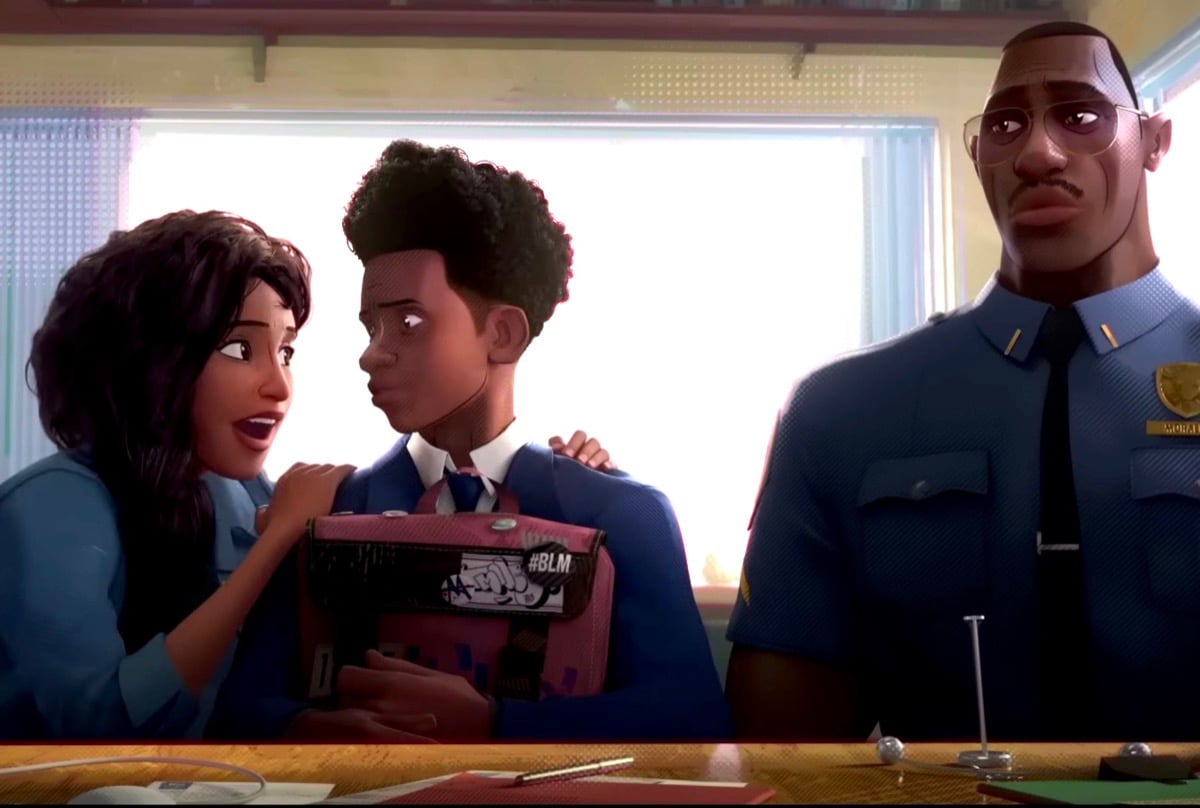
People of color are represented in a nuanced and complex manner, in which other productions have often failed. Miles Morales, the protagonist, is a mixed race African American Teen. He has a Black dad, and a Hispanic mom. At school, he is studious and diligent in his studies. He also enjoys Comics and Hip Hop and shoes. All of these elements, paint a vidid picture of what a genuine experience as a person of color may look like. The creators of the film intentionally include some character traits that are stereotypical while others that are not to create a character that appears unique and genuine. Often in media, underrepresented groups are written as a very specific stereotype. For African Americans, the most common types would be either a super nerd, who has little to none stereotypical traits, or a character who embodies all the stereotypes around African Americans. Spiderverse doesn't paint this experience as a monolith, and does not rely on any one stereotype to create its characters. Instead it blends different elements, to show how in life, people are complex and don't fit into a box of stereotypes. 

 New 'Across the Spider-Verse' Clip Shows Miles Morales' 'Spanglish' | The  Mary Sue 

Miles Morales with family in Spiderman Across the Spiderverse (2023)

Women are another underrepresented group that has diverse and unique representation. Jessica Drew, one of the main spider-people in the second film is a pregnant woman, yet she still does all the things that a spider-person can do. She is not treated as incapable because she is pregnant, instead she still powerful and takes on all the normal roles and responsibilities of her job, just like pregnant women do in real life. Traditionally, women who are placed in powerful roles in cinema, have been taken of their feminine traits or made seen as only the 'powerful independent woman' trope. Instead of playing into this trope, Jessica Drew's character simply portrays her as any other character and being pregnant is not used as her only personality trait. She is a complex, competent character like any other, who also happens to be pregnant. This kind of casual representation, achieves an authentic representation of reality, and shows that people aren't solely defined by any one characteristic. Additionally, she is also a black woman, which is an even more under-represented group in cinema. Both of these traits, represented in one character, creates a truly unique representation between the intersection of two under-represented groups.

Jessica Drew in Spiderman Across the Spiderverse (2023)


The film also represents a variety of different cultures. In the second film Pavitr, a spider-man from Mumbay, India, takes a big role in the film, giving representation to a culture to a group that faces little in the superhero genre. He is depicted with a slight accent, that may sound stereotypical, but has been recognized by Indians as authentic and accurate to the 'imperfect' English Pavitr would have in real life as someone who speaks it as a second language. The film does not make fun of his accent, as many films do with Indian accents, instead its simply a part of the character. There are also authentic parts of his culture thrown in, which give him a genuine appearance that does not seem 'whitewashed'. For instance, he laughs at Miles Morales saying "Chai Tea", which translated from his language means "tea tea". This is an event that many Indian people can likely relate to, which deepens their connection to this character, and make them feel represented in the superhero genre.

 
Pavitr Prabhakar in Spiderman Across the Spiderverse (2023)